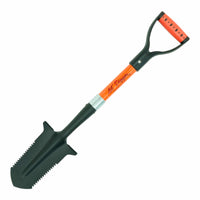
Why Your Digging Tool Is as Important as Your Detector
A garden trowel will leave ragged holes and bent blades after one afternoon in clay-heavy soil. The right metal detecting shovel or digger tool keeps you in the field longer, protects turf, and speeds recovery so you cover more ground per session. Cheap hardware-store tools twist at the tang, dull on gravel, and telegraph vibration into your wrist with every thrust. Purpose-built treasure hunting tools use heat-treated steel, reinforced sockets, and blade geometries proven across millions of plug cuts. The difference shows up in your finds-per-hour rate and in how your hands feel after a six-hour hunt with your metal detectors.
Full-Size Metal Detecting Shovels
Long-handle shovels move soil fast for digging deep relics or working plowed fields. Blade geometry matters: serrated edges saw through root mats and compacted clay, while straight-edge models slice cleaner plugs in manicured turf. Fiberglass shafts absorb shock and resist bending. Steel shafts add heft for breaking hardpan. T-handles give you a two-handed pivot point for leverage, while D-handles suit one-handed scooping and throwing. Lesche pioneered the category with the T-Handle Serrated and Sampson models, both still benchmark standards. Garrett, Motley, and TerraX round out the long-handle lineup with different blade widths, step profiles, and handle styles to match specific terrain and digging styles.
Serrated Blade vs. Straight Edge: Which Cuts Better?
Serrated blades win in rooted grass, sod-bound parks, and any soil laced with fibrous roots. The teeth saw through obstacles that a straight edge would tear or bounce off. Straight edges shine in loose dirt, sand, and gravel where speed matters more than cutting power, and they sharpen faster in the field with a basic file. For most detectorists hunting mixed terrain, a serrated blade pays for itself within the first few hunts.
Handle Type: T-Handle, D-Handle, or Ball?
T-handles deliver maximum leverage for hard soil and deep relic work. Two hands on the bar mean you can twist, pry, and pivot without the shaft slipping. D-handles offer better control in tight spots and one-handed scooping near root systems or sprinkler heads. Ball handles sit between the two, prioritizing all-day comfort over raw torque. Match the handle to your typical hunting ground rather than chasing a one-size answer.
Hand Diggers, Trowels & Probes
Most park and tot-lot finds sit within six inches of the surface, where a metal detecting hand shovel or compact digger tool outperforms a full shovel. Hand digging tools let you kneel, control plug depth, and work around sprinkler heads or tree roots without dragging a long handle. Serrated models cut sod edges cleanly, reducing tear-out and speeding refill. Look for one-piece forged construction or a fully welded tang. Riveted handles loosen under torque. A narrow blade profile, typically under three inches wide, minimizes turf disturbance and meets park regulations in restrictive municipalities. Pair your hand digger with a quality pinpointer for faster recovery once the target is locked.
Picks & Mattocks for Rocky and Mineralized Ground
Gold prospectors working desert washes, volcanic slopes, or glacial till need a pick to break crust before any shovel can bite. A hunting shovel alone will bounce off caliche or shale. A solid gold shovel setup pairs a pointed pick head with a flat chisel edge to fracture rock and pry cobbles. Apex Picks are purpose-built for this work, with drop-forged heads and hickory handles that absorb impact without splintering. Mattocks add a broad adze blade opposite the pick point, letting you chop roots and scrape overburden in one tool. For a full gold prospecting equipment kit, a pick is as essential as your detector coil.
How to Choose the Right Digging Tool for Your Terrain
The best metal detecting shovel matches the ground you hunt most often. Use this terrain-to-tool reference as a starting point:
- Turf and parks: serrated hand digger or narrow-blade full-size shovel for clean plugs and minimal trace
- Sandy beaches: sand scoops and beach digging tools move volume far faster than a shovel ever will
- Plowed fields and farmland: long-handle shovel with a wide blade for fast soil movement
- Rocky ground and hardpan: pick or mattock to fracture surface before digging
- Mineralized soil and gold country: pick paired with a narrow hand digger for crevice work
- Clay and heavy loam: fiberglass-handle shovel that flexes rather than transmits shock
- General all-terrain: stainless serrated hand digger plus a full-size T-handle covers most situations
If you split time between coin shooting and relic hunting, a two-tool system covering both close-in hand work and deep recovery will outperform any single compromise design. The best shovel for metal detecting is the one matched to your most frequent hunting ground, not the priciest option in the catalog. Detectorists who travel to multiple regions often build a quiver: a long-handle shovel for fields, a serrated hand digger for parks, and a pick for prospecting trips. For more information on which shovel is best for you, visit our Lesche Comparison guide.
Shop by Brand
Lesche remains the benchmark for T-handle and Sampson shovels, with heat-treated blades and strong manufacturer warranties. Apex Picks deliver drop-forged pick heads and mattocks for prospectors working hardpan and rocky ground. Garrett brings the same engineering rigor to its digging tools that built the brand's detector reputation. Motley Digging Tools, Quest, and TerraX round out the lineup with compact diggers, trowels, and full-size shovels suited to coin shooting, relic hunting, and field work. Dune Scoops handles the sand-and-surf side of the catalog when your hunting ground runs to the waterline. Need replacement handles, blade covers, or sharpening files? Browse our parts & accessories collection.